
The situation
A director was enthusiastic about AI. There were Lunch and Learns. There were Slack posts. Inside the teams, almost no one engaged.
Seven pizza teams across Berlin, Amsterdam and the UK. Licences were not the problem. People were hesitant, some went quiet, others opted out. The tools were there. The practice was not.
The first attempt, which failed
I built a multi-agent scrum system and got resistance. I had led with the technology — the same mistake as everyone above me.
That failure is the point. If you start with a demo of what the model can do, you get applause and then nothing. People will not learn something they are afraid to be bad at in public, and a dashboard tracking their usage only makes it worse.
What changed
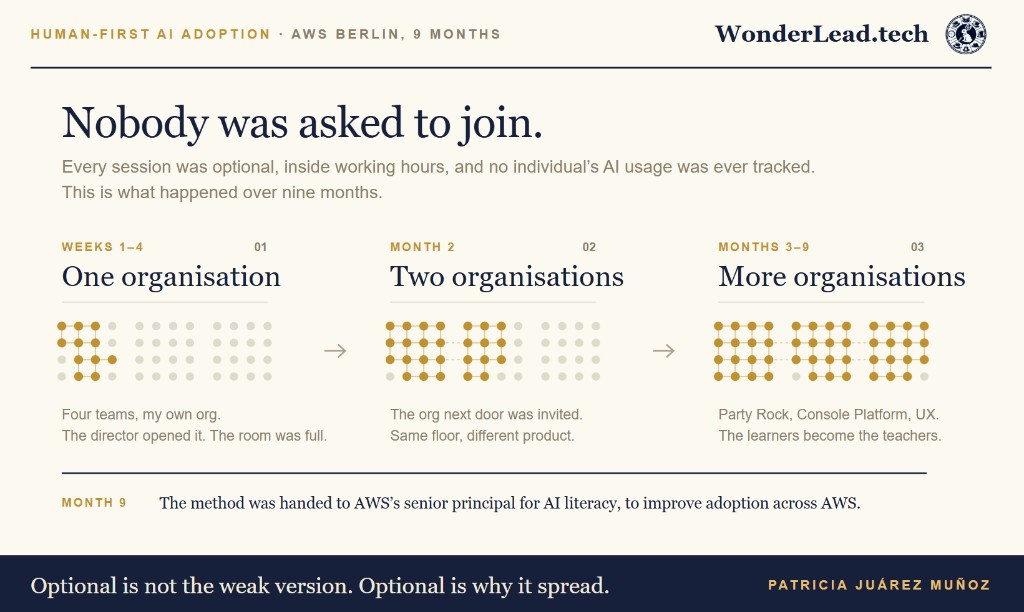
Bottom-up sessions. Optional. In working hours. No usage tracking. Deliberately no metrics in phase one.
We started where adoption actually happens: in one person’s daily habits, and in a team’s shared sense that it is safe to be a learner. Every role was in the room — engineering, design, product — on real work, not fictional exercises.
What happened
One team to seven. Seven to three organisations sharing a floor in Berlin. Different products, same problem. Nine months.
People who had never touched AI were building on-call agents and design-system automation, and demoing them. Learners became the teachers. A cross-org guardrails working group formed because people wanted one, not because a slide said they should.
How it was measured
Behaviour first, outcomes after. We did not count seats. We watched who showed up, who asked, who demoed, and who taught.
Behaviour over nine months
Qualitative, on purpose. Phase one had no usage dashboard. The numbers that mattered were people choosing to come back, asking in public, demoing work, neighbouring teams asking to join.
What it ended with
The findings were handed to AWS’s senior principal for AI literacy, who agreed to apply the approach. On the last day, the director thanked me for the method.
WonderLead exists to bring that method to other companies: a practical way to get real people to change how they work, drawn from having actually done it.